Just finished this - making two identical for a friend to give as Christmas gifts. The second one still needs the clasp. This is approximately 60 feet of 26 ga sterling wire, woven around a dowel and drawn through a draw plate through successively smaller holes until it is tight.
The pendant is fine silver, dapped, with a freshwater pearl dangle. The clasp is pewter, sterling, freshwater pearls and Swarovski crystals. I'm very happy with it. I think I'll make the pearl jump ring a little smaller so it dangles instead of hitting bottom. :) When my e-commerce site goes live in January, I'll have professional photos and these will be for sale on a commission basis, with choices of metals and stones.
Search This Blog
Friday, December 20, 2013
Silver Viking Weave Necklace With Pearls
Labels:
dapped,
fine silver,
jewelry,
necklace,
pearl,
pearls,
pewter,
silver,
sterling silver,
viking basket weave,
viking chain,
Viking weave
Friday, August 2, 2013
Silver and Rocks. My Two Favorite Pieces
These are two pieces I made a few years ago. They are both sterling silver and the ginkgo leaf was made from using an actual ginkgo leaf I found as a template. That piece is set with brown labradorite. The other piece is my take on Danish Modern, and is a simple shape that my saw just decided to cut. It's set with a rhodochrosite.
I love both of them. I want to get back into a studio that has appropriate equipment so I can make more!
The photo below is of the brooch prior to actually setting the stone. I had not pushed the bezel into place on the stone.
Labels:
ginkgo leaf pendant,
jewelry,
labradorite,
lapidary,
leaf pendant,
rhodochrosite,
silver,
silver jewelry,
sterling,
sterling silver
Sunday, July 21, 2013
Got Pearls?
So...in 2006 I went to a bead and gem show when I was living in Richmond, VA. I went on the last day of the show - you know how that goes. Everything is marked waaaay down because those vendors don't want to pack it up and take it home. I spent $300 that day and I'm still using up that stock. I bought these pearls simply because they were so pretty. I wasn't a very good beader then, and I had no clue how to use them. So they sat. And sat. And moved when I moved. They got looked at, fondled, arranged, and finally, yesterday, I decided to use them. This is the beginning of a sterling bangle that will have the teardrop pearls wired on one side and probably 8mm jet Swarovski on the other side. Onyx would be better, but I'm out. The Swarovski top-drilled bicone is set off-center because the other side will have one set just off center in the other direction.
Once finished the entire piece will be wrapped with 28 ga fine silver, and all wires that show will be brought in close with pliers and tucked in before the final wrap starts. The clasp will be an S-hook with a closed end.
Doesn't look like much now, but I'll photo again when finished. It'll be an interesting contrast of black and white. I think it'll turn out well. We'll see. :)
Labels:
crystal,
fine silver,
freshwater pearls,
pearls,
sterling,
sterling silver,
swarovski,
wire wrapping
Sunday, June 23, 2013
Beaded Copper Wreath
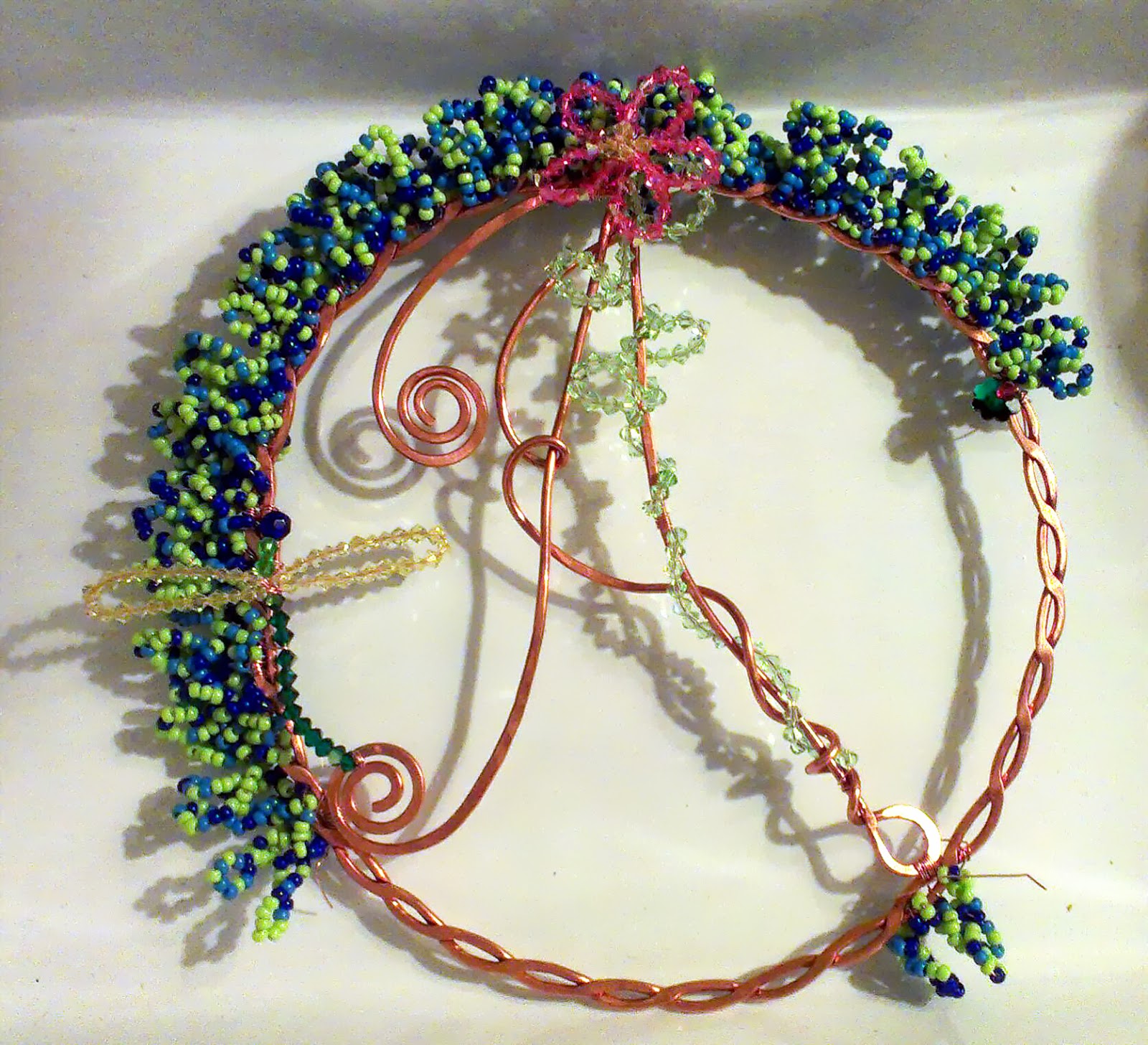
This is a wreath/suncatcher that I made for my neighbor's baby. The frame is 12 gauge round copper wire, twisted and then hammered flat to create open links so beads can be wired to it. The wreath is 8" in diameter. I got lucky with this - the baby's nursery contained colors of beads that I already had. The seeds around the outer rim of the frame are 8/0 Toho in three shades of blue and grass green. The inner rim of the wreath has been wired with 4mm Swarovski crystals in Dark Rose AB (I think that's the color!). I have tons of these from a bulk purchase I made years ago. The flower is also Swarovski, in 4mm using the same pink for the flower, yellow 3mm for the center, and 4mm chrysoprase (again - I think this is the color!) for the stem and leaves. The dragonfly is a mix of Swarovski pinks and sizes.
The initial in the middle is a stylized A, made from 14 ga round copper wire, and selectively hammered. It's a heavy piece!
You can see the frame below. The frame, by itself would be lovely, but I wanted to match colors with the little new person's nursery. Actually, the frame is pretty versatile. You can use it for a lot of different decorative purposes. It's sturdy and if you don't solder, it's easy to wire the ends closed so they never come apart. If you're using the frame without decoration on it, I suggest soldering so the wires don't show.
Labels:
beaded,
beaded wreath,
beads,
copper,
crystal,
dragonfly,
nursery decor,
Seed beads,
swarovski,
Toho,
wire alphabet
Wednesday, May 29, 2013
Hammered Copper Sweater Pin
So, I saw something similar to this recently and I thought, "Hey- I have all that 14 and 16 ga wire. This is a good use for it! So I decided to try a pin. I already knew how to make a pin back, since I'm a metalsmith (without an equipment-filled studio at the moment!), and I wanted something that was completely cold-connection because it can be difficult to solder heavy gauge metal with a micro-torch. This is two pieces of 16 ga wire. It's sturdy and it is most definitely a sweater pin. You don't want to put that pin back in a tee shirt or delicate blouse. You'll have a hole that won't go away. But for cardigans, winter scarves, and more loosely or bulky knitted items, this is a fabulous accessory.
I re-learned a few techniques on it, and one of the basic rules of metal working: get your shape the way you want it BEFORE hammering. DUH. Naturally, there will be a few adjustments to make afterwards, but for the most part you want your piece to be in the shape you want it to be before you start hammering it. Hammering, and working the wire in any fashion will work-harden it. This is dead soft wire, stripped from an electrical cable. I have tons of it. Stripping it is difficult because you can't use wire strippers. They mar the metal and create weak points. I strip mine by laying it on a piece of plywood and using an exacto-knife very carefully. Give it a try - this was quick and easy to make and while I'm going to re-make it, since this was a prototype, I'll wear this one this winter.
Remember, when making your pin back, you must twist that wire until it's straight and it provides tension against the clasp or hook. I don't have the hook on this yet, but that pin back won't buckle under pressure. Also, when filing the end to a point, remember that sharp objects can draw blood and tear clothing, so don't make it too sharp. It's for sweaters - it doesn't have to be super sharp.
I re-learned a few techniques on it, and one of the basic rules of metal working: get your shape the way you want it BEFORE hammering. DUH. Naturally, there will be a few adjustments to make afterwards, but for the most part you want your piece to be in the shape you want it to be before you start hammering it. Hammering, and working the wire in any fashion will work-harden it. This is dead soft wire, stripped from an electrical cable. I have tons of it. Stripping it is difficult because you can't use wire strippers. They mar the metal and create weak points. I strip mine by laying it on a piece of plywood and using an exacto-knife very carefully. Give it a try - this was quick and easy to make and while I'm going to re-make it, since this was a prototype, I'll wear this one this winter.
Remember, when making your pin back, you must twist that wire until it's straight and it provides tension against the clasp or hook. I don't have the hook on this yet, but that pin back won't buckle under pressure. Also, when filing the end to a point, remember that sharp objects can draw blood and tear clothing, so don't make it too sharp. It's for sweaters - it doesn't have to be super sharp.
Labels:
brooch,
copper,
copper wire,
metal work,
pin
Monday, May 27, 2013
Another Viking Weave Bracelet
This is another Viking weave bracelet that I've just finished. I made my own ends by coiling 20 ga dead soft wire around bail making pliers that match the size of the bracelet, and then used the wire tail to create a spiral "cap" to cover the ends of the bracelet. The beads are chrysocola (sp?) and a 4mm sterling bead, and the bracelet is finished with an S hook clasp. I need to re-do the jump ring attachments - was trying for a look that didn't succeed, so those are on the list for a do-over. :)
Sunday, May 26, 2013
Silver Filled Wire vs Sterling Silver or Fine Silver
As a rule, I've always worked in sterling silver or fine silver. With the price as it is right now, it's affordable, but if what I've been reading is any indication, silver is about to skyrocket and by 2014, will be unaffordable for the average artisan. Silver filled wire is an excellent alternative. It wears the same as sterling, it works just as well, as long as you don't use abrasives to polish or buff it. You have to be careful with that because in polishing and buffing, you will wear away layers of silver and base metal may start to show.
People who say they can only wear gold or silver can also wear silver filled or gold filled jewelry. It lasts very well, is a fraction of the price of the precious metal, and if taken care of, will last just as long. I have gold filled pieces that are more than 100 years old and still have the luster of high karat gold, so don't let your customers think they're getting any less for their money.
Silver filled metal and wire is made according to the diagram graciously provided by Rio Grande, pictured below:
People who say they can only wear gold or silver can also wear silver filled or gold filled jewelry. It lasts very well, is a fraction of the price of the precious metal, and if taken care of, will last just as long. I have gold filled pieces that are more than 100 years old and still have the luster of high karat gold, so don't let your customers think they're getting any less for their money.
Silver filled metal and wire is made according to the diagram graciously provided by Rio Grande, pictured below:
I intend to start using this for all my head and eye pins and ear wires. I will always have sterling on hand for those customers who absolutely insist on sterling earwires, but if a customer is willing to be educated, they will see that this is a fabulous alternative and it makes the jewelry affordable to them. If silver goes higher than $50 a troy ounce, as it's predicted to go - some say as high as $250 a troy ounce, who will be able to afford to buy it, and/or buy pieces made with it? I don't know about you, but my small sales are the bread and butter of my business. The earrings I currently sell for $20 would wind up being more than $100 a pair and I don't think my customers would buy. They can't afford it.
Give it a try. It works just as well as sterling or fine silver. It solders well (use silver solder) and it patinates just as well as sterling or fine silver.
Labels:
fine silver,
silver,
Silver Filled,
Silver-Filled,
sterling
Saturday, May 25, 2013
Viking Weave In 26 Gauge Sterling Wire
I did this last night - it's my third attempt at this technique and it came out much better than the one in the photo below. Practice makes perfect. I'll turn it into a bracelet, as is.
Labels:
silver,
sterling silver,
Viking weave,
Viking weave bracelet,
woven wire
Viking Weave Bracelet With Freshwater Pearls
Just finished this today. The bracelet is viking weave done with 30 ga dead soft fine silver wire, and the pearls are 3mm freshwater gray pearls wired to the weave. This is my first attempt at viking weave with precious metal - I practiced once on some nasty brass wire, got the hang of it and made this. The chain came out a bit too flexible for my taste, so I decided to wire the clusters of pearls to give it some strength. I used grape leaf motif bead caps to finish the ends, since the pear clusters reminded me of grape clusters. I don't like the black crystals on the ends, so will probably take them off and just use the sterling beads. I think the grape leaf bead ends are a bit heavy for it, both aesthetically and weight-wise, but I didn't have any others in sterling at this point. It's not perfect, but not bad for a second try!
Friday, May 17, 2013
Blue Swarovski Waterfall Earrings
Made these yesterday. Silver plated square wire and graduated sizes and shades of blue and aqua Swarovski crystals.
Labels:
earrings,
handmade jewelry,
silver,
Swarovski Crystal Earrings
Sterling Silver Woven Wire Fish Earrings
These are my latest creation: Sterling frames wrap/woven with 28 ga dead soft fine silver, and Swarovski beads. The earwires are handmade as well. These take about 90 min per earring to make and while easy to make, it can get tricky keeping the weave tight, especially as you get toward the top.
Labels:
beads,
crystal,
earrings,
fine silver,
fish,
handmade jewelry,
sterling silver,
swarovski,
swarovski crystal beads,
wire weaving
Sunday, May 12, 2013
Pricing Hand-made Jewelry Correctly
Ever browsed Etsy or Artfire and seen all those shops with lovely items priced extraordinarily low? And then, when you look at the artisan's sales you find they aren't selling a lot. Here's what I've learned about selling hand-made jewelry online and at craft shows, in case you're interested.
- Profit is not a dirty word. If you are selling something you expect to make a profit, right?
- Hand-made is not synonymous with cheap.
- My time is worth money.
- Buyers can smell a lack of seller confidence. It shows in descriptions, pricing and photography.
- The items I create are worth more than any mass-produced item, since no one else has one like it.
Now, how do you price correctly?
- Know the current market value of your supplies and mark them up at least 100%. Just because you got something on sale doesn't mean you lower your price. You may not find that item one sale again when you run out.
- Think about a labor cost. This is important. If you do not charge for labor you are cheating yourself. Do you think the stores and boutiques where you might shop don't have labor costs built into their prices? Don't sell yourself short.
- If you have to ship an item and decide to offer free shipping, make sure you have calculated the cost of shipping and shipping supplies into the price of your item, otherwise you are losing money.
- If you plan to sell at craft shows, it's wise to assess your market first. Go to local craft shows and watch who is selling and what types of items are selling and for what prices. Know your customer base. If you sign up for a craft show in an area where people are interested only in spending less than $20 for an item, then don't put your best, most expensive items out. They won't sell. Gear your inventory toward the show. Know the demographic that is expected to attend. Plan your inventory accordingly.
At craft shows, always have supplies on hand to custom-make pieces, and always have pieces to work on so customers can see how your lovely items are made - so they can see the work that goes into them. If you're just sitting there with all your pretties laid out, customers will treat it as they would the jewelry rack at a big box store and look for the bargains, and if they don't find any to suit, they will then attempt to haggle with you over price, because to them, it's just another jewelry booth. If they see you working that allows them to come watch and ask questions. You can show them that you are making a pair of earrings or a necklace similar (but not the same) as something you have displayed. They can see that there is labor, time, effort and sometimes back breaking labor, that goes into these creations. Let them see the callouses on your fingers!
If you have done your research and assessed your demographic appropriately, you should have no problem turning a profit at a craft or art show. People want to believe they are getting value for their money, HOWEVER, when they see a pair of earrings that are created from sterling silver and unique bead components and that pair of earrings is priced at $12, they may look at them, but odds are good they won't buy. Why not? You're cheaper than the stores! That's why not. When a pair of sterling silver earrings costs upwards of $50 for something basic and you're selling them for $12 your credibility is called into question. If you don't put a fair market value on your creations, customers won't believe your items are worth purchasing. They will smell your lack of confidence in your own creations and move on.
Is everyone going to buy? No. Some people will be outraged that you'd charge "that much" for something "hand made." So what. Smile and move to the next customer who is actually going to purchase your hand-made item for "that much."
Remember, if you are setting up at a craft show, you only profit once you've covered your supply and labor costs, booth rental, and travel and meal expenses. That means gas and mileage, too...
I'm always open to comments and suggestions, so anyone who has some good input on this subject, please post a comment. I've covered things in brief, and need to head to bed now. It's pumpkin time. :)
Happy creating, everyone!
Tuesday, February 14, 2012
And Now For Something (Almost) Completely Different!
Started this two months ago and then, in my usual ADD fashion, allowed the call of pretty new beads to lure me away. Finished the basketweave and everything else tonight. It's an agate slice wrapped in pure copper viking basketweave, topped with a brown iris druk teardrop and copper tube for the hang hook. The bottom is hung with copper shadow Swarovski (I think that's the name) 6mm, and two copper tubes terminating in the same Swarovski bicones.
To me, it's got kind of a dream catcher-ish look to it. I like it. It's not my usual suncatcher fare and I hope to rephoto tomorrow as it hangs in my window (prior to being placed for sale in my shop) with the sun streaming through it.
Labels:
agate,
beaded suncatcher,
copper,
dreamcatcher,
druk,
swarovski,
viking basketweave
Thursday, November 3, 2011
Amazing What You Can Do With Beads!
This is a beaded garland that I finished up about 3 weeks ago. It just sold at the local gift shop. It's approximately 4 feet long, with a mix of brightly colored beads spun on craft wire. The embellishments range from french beaded flowers to Swarovski crystal dragonflies and lots of stuff in between. It's a great way to let your imagination loose. The woman who bought this is using it on her Christmas tree this holiday season and then will use it in her sun room, looped and swagged in front of the windows so the crystals catch the light.
Labels:
beaded flowers,
beaded garland,
beaded suncatcher,
french beaded flowers,
swarovski,
victorian beading
Wednesday, November 2, 2011
Earrings!
A few easy-to-make earrings created by yours truly. All of these have hand-made earwires. Making earwires is easy. I would strongly suggest that you never buy another earwire, since you can make them yourself much more cheaply.
All you need is wire, pliers, a mandrel (I use both of the ones shown in the link image and they are well worth the money), a bench block or steel block for hammering. Make sure your block is smooth and free of gouges. If yours is like mine was, you may need to use an angle-grinder to get it back to smooth. More about that later!
I also suggest using a rawhide mallet or a hard plastic mallet so you don't mar your wire. Years ago, before I bit the bullet and paid what I thought was an atrocious amount for my rawhide mallet (it's invaluable to me now), I would place a piece of suede over my findings before hammering with my chasing hammer. Still not a great way to do it. At least purchase a hard plastic mallet. Beadsmith makes one and it's very affordable. You can buy it here: Dual Head Plastic Mallet and you can also purchase replacement heads for it. I use this for smaller items rather than trying to work small with a big rawhide mallet. :)
All you need is wire, pliers, a mandrel (I use both of the ones shown in the link image and they are well worth the money), a bench block or steel block for hammering. Make sure your block is smooth and free of gouges. If yours is like mine was, you may need to use an angle-grinder to get it back to smooth. More about that later!
I also suggest using a rawhide mallet or a hard plastic mallet so you don't mar your wire. Years ago, before I bit the bullet and paid what I thought was an atrocious amount for my rawhide mallet (it's invaluable to me now), I would place a piece of suede over my findings before hammering with my chasing hammer. Still not a great way to do it. At least purchase a hard plastic mallet. Beadsmith makes one and it's very affordable. You can buy it here: Dual Head Plastic Mallet and you can also purchase replacement heads for it. I use this for smaller items rather than trying to work small with a big rawhide mallet. :)
These are turquoise beads with a "bezel" of 2mm sterling beads
These are copper tubes, freshwater pearls, sterling and copper beads with sterling earwires.
These are some fun earrings I made with copper wire and garnet beads
These are freeform sterling wire earrings - not my best effort, but fun and easy to make. They terminate in copper and garnets. I probably should have soldered the top loop and my camera is better than the human eye, because it picks up things like cut marks made from my flush cuts. That's a good enough reason to file and solder.
These are twisted 18ga square sterling wire, hammered and formed (with half-round pliers), and garnet beads on pure copper head pins.
None of these earrings required soldering, but if you want to make absolutely positive your jump rings won't come apart, you should probably hit them with a torch and solder them closed, if possible.
I also find that when making earwires, a very easy way to smooth the "pointy" ends is with a metal nail file. Seriously. This actually works better for this purpose than any jeweler's file I've used. It's quick, easy, and you're not as likely to take off as much of your fingernails with it as you would a jeweler's file. :)
If you have a steel-shot tumbler, it's a good idea to throw all your findings in it for a bit to harden them up, especially if you're working in dead soft wire. If you don't have one, though, you can work-harden by straightening your wire with a polishing cloth - just run it the length of your wire several times, and/or by lightly hammering when you're finished making earwires. Jump rings and pins should be put in a tumbler or made with half-hard wire if at all possible.
I use fine silver or Sterlium for my earwires and other findings. Sterlium is alloyed with Germanium and doesn't show firescale the way sterling silver does. Sterling will show firescale when heated because of the copper alloy. You'll see a darkening after you fire it, and although pickle will remove a bit of this, you'll still be left with some dark spots. The only time efficient way to deal with that for something as small as a finding is to tumble the item to polish it. Fine silver won't show fire scale because there's no copper in it. It's .999 silver which is pretty darned close to pure silver.
Monday, October 31, 2011
Beaded Christmas Ornament
This one does double duty. It can be hung on the holiday shrub and it can be hung in a sunny window year-round to add some rainbows in your life. I went a bit overboard on this - the frame is 18 ga twisted square sterling silver wire. All the beads except for the cloisonne heart are Swarovski bicones.
And from a different angle:
Labels:
beaded dragonflies,
beaded suncatcher,
beads,
christmas,
christmas ornament,
ornament,
sterling silver,
swarovski
Beaded Wreath Christmas Ornament
Just finished this. I'm very happy with the way it turned out. How is it made? Simple! I used a round base that had holes in it, but you could just as easily use heavy gauge wire for your base. The greenery is a mix of green seeds (greenery isn't all one color of green!) spun onto 24 ga brass wire. I spun just enough for each "branch" at a time, wired it down to the base, and then spun the next branch. The red beads are round garnet-colored czech glass, 6mm. I'd add one to the wire every few branches and then spin the green seeds on. Each branch is twisted for texture. I simply kept wiring around the form until I got it looking the way I wanted it. The loop is 4mm garnet Swarovski bicones.
This one is Swarovski crystals attached to a 20 ga copper base. I simply coiled copper wire around a dowel, pulled it off, and then carefully stretched it apart until the loops created by the coils showed individually. I looped one end with my pliers and hooked the opposite end of the stretched coils to it to make a circular base.
It's important to hammer this type of base to flatten it, but you don't want to hammer too hard because you may weaken it. Just give it a few whacks with a plastic or rawhide mallet.
This one is Swarovski crystals attached to a 20 ga copper base. I simply coiled copper wire around a dowel, pulled it off, and then carefully stretched it apart until the loops created by the coils showed individually. I looped one end with my pliers and hooked the opposite end of the stretched coils to it to make a circular base.
It's important to hammer this type of base to flatten it, but you don't want to hammer too hard because you may weaken it. Just give it a few whacks with a plastic or rawhide mallet.
Friday, June 17, 2011
PMC Dried Out? Try This
I tried this on a lump I've had for four years, because I'm getting back into PMC/Art Clay. I dug up my lump and it was rock hard. Okay - what is PMC made of? Fine silver, binders and water. Why does it dry up even if it's still in an unopened package? Water evaporates. Doesn't matter what it's in, really - it will evaporate.
All you need to do to get your clay workable again is follow these instructions. It works. I tried it - it's from Tim McCreight's PMC Guild website.
PMC is made of particles of precious metal, an organic binder, and water. The precious metal and the binder stay the same, but it's possible for the water to evaporate over time, even though the PMC has never been opened. If, when you open the box, the PMC is stiff and hard to form, it simply needs more water.
I've successfully re-hydrated PMC that had dried out rock-hard. It's easy to do: open the box and hold the lump of PMC under running water for a few seconds so its surface gets totally wet. Rewrap it in cellophane and set it aside overnight, periodically kneading the lump through the cellophane. The goal is to get the moisture into the PMC. This takes time because it is a very dense material. Unwrap and test the PMC: you should be able to flatten it into a disk without cracks appearing at the edges. If it's still too stiff, wet and rewrap it again and let it sit longer. Two treatments are usually enough, but you may continue until the PMC returns to its original, soft, workable consistency.
Also you can grind the clay up in a spice grinder or pepper grinder into a fine powder, then slowly add water drop by drop allowing time for the moisture to absorb.
This totally works (Tim McCreight is AWESOME) but you MUST be patient. Don't try to work your clay if it has cracks in it the first time you test it after adding water. Just add a few more drops of water, wrap it up again and let it sit overnight - knead it through the wrapping just as you did the first time and test again. You may need to do this a few times depending on how dry it is, but it DOES work. PMC and Art Clay are way too expensive to throw out just because they dried out. So be a smart artisan; rescue and reuse!
All you need to do to get your clay workable again is follow these instructions. It works. I tried it - it's from Tim McCreight's PMC Guild website.
PMC is made of particles of precious metal, an organic binder, and water. The precious metal and the binder stay the same, but it's possible for the water to evaporate over time, even though the PMC has never been opened. If, when you open the box, the PMC is stiff and hard to form, it simply needs more water.
I've successfully re-hydrated PMC that had dried out rock-hard. It's easy to do: open the box and hold the lump of PMC under running water for a few seconds so its surface gets totally wet. Rewrap it in cellophane and set it aside overnight, periodically kneading the lump through the cellophane. The goal is to get the moisture into the PMC. This takes time because it is a very dense material. Unwrap and test the PMC: you should be able to flatten it into a disk without cracks appearing at the edges. If it's still too stiff, wet and rewrap it again and let it sit longer. Two treatments are usually enough, but you may continue until the PMC returns to its original, soft, workable consistency.
Also you can grind the clay up in a spice grinder or pepper grinder into a fine powder, then slowly add water drop by drop allowing time for the moisture to absorb.
This totally works (Tim McCreight is AWESOME) but you MUST be patient. Don't try to work your clay if it has cracks in it the first time you test it after adding water. Just add a few more drops of water, wrap it up again and let it sit overnight - knead it through the wrapping just as you did the first time and test again. You may need to do this a few times depending on how dry it is, but it DOES work. PMC and Art Clay are way too expensive to throw out just because they dried out. So be a smart artisan; rescue and reuse!
Monday, June 13, 2011
SQUAWK! Bird Houses Like You've Never Seen them!
This week's featured Artisan, Syd Baker,a former Hallmark Artist, is using his gifts to give our feathered friends lovely custom homes. Syd's shop, SQUAWK, is chock full of avian architectural delights.
These birdhouses are specifically built to attract the smaller birds. These whimsical custom homes will bring a smile to your face as well as to all the chickadees and goldfinches in your area. Keep a close watch and you WILL see a bird smile. Truly. Keep an eye on his shop, too, because he'll have Squawk miniatures for your holiday shrub later in the year!
To learn more about Syd and his wellspring of creativity, check out his website: Other 3D Lands. You will be amazed, amused and I bet you'll giggulate as much as my friend, Becky, does!
These birdhouses are specifically built to attract the smaller birds. These whimsical custom homes will bring a smile to your face as well as to all the chickadees and goldfinches in your area. Keep a close watch and you WILL see a bird smile. Truly. Keep an eye on his shop, too, because he'll have Squawk miniatures for your holiday shrub later in the year!
To learn more about Syd and his wellspring of creativity, check out his website: Other 3D Lands. You will be amazed, amused and I bet you'll giggulate as much as my friend, Becky, does!
Tuesday, May 24, 2011
Bead Crochet- Literally!
When bead artists talk about bead crochet they're speaking of crocheting with some sort of string that's been strung with beads and on the yarn-over, feeding beads down. Me? I took it a step farther. I spun around two yards of Supplemax with a seed mix, and tied off the ends. Then I literally single-crocheted the bead string itself. No yarn-over, no feeding of beads. This one is an experiment. It's a row of chain stitch to 6.5 inches and a row of single crochet back. Next one will be two rows of single crochet and then I'm going to fold it in half, length-wise and stitch the side closed with supplemax. It's clear so it can't be seen, especially if you're feeding it through beads as you go. Go up and down the seam two or three times for strength.
On this one, I'll make the clasp loop out of stretchy so that the loop doesn't have to be huge. I kinda like this idea. I'm sure "true" bead crochet people would gasp in horror, but hey - what's art about if not creativity and innovation?
Subscribe to:
Comments (Atom)